How to prioritize competing deadlines: what to do first
When several deadlines compete, sort them by how much of their time is left, then by what a slip would cost. A worked example, and how to do it on your Mac.
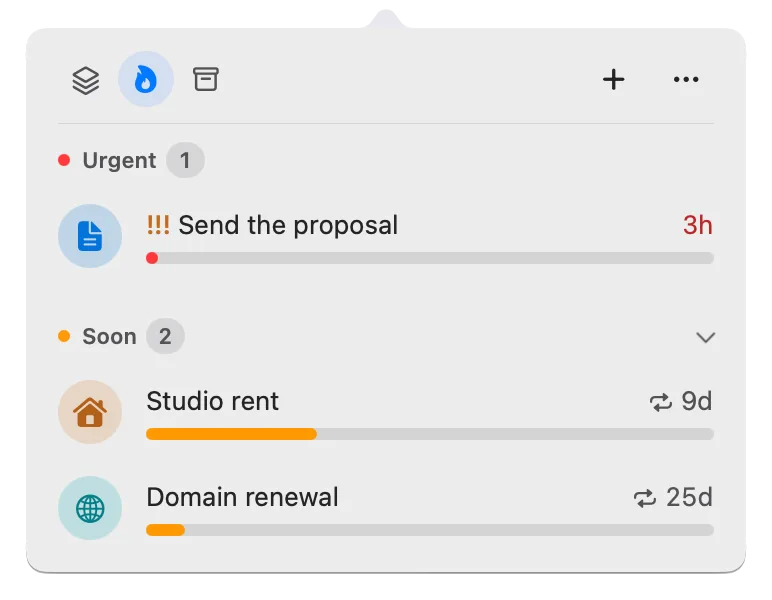
When several deadlines compete, the nearest due date isn’t always the one to start. A useful rule of thumb: start with the deadline that has used up the most of the time it was given. When two are about as far along, let what a slip would cost decide. Then check how much work each needs, because no rule based on time can see that.
Deadline Bar is a Mac app that keeps your deadlines in the menu bar at the top of your screen and lists them most urgent first. This guide explains a way to choose, where it fails, and exactly how Deadline Bar orders your list. Everything here works in the free version.
Sort by time left first, then by what a slip costs
Sort deadlines into a few bands by how much of their own time is left, and let importance decide only inside a band. Between deadlines that are equally important, the nearest due date goes first. Deadline Bar adds one more rule: a deadline in its last hour moves to the top of its band.
In Deadline Bar, a deadline’s time counts from the start of the day you add it (or from a start date you set), not from when you were given the work. Work you were handed two weeks ago and add today counts as if you got it today, so it ranks lower than it should. Add deadlines the day you get them.
Why time comes first
A list can’t see effort, but it can see how much of each deadline’s window is gone. That’s a stand-in for effort, and often a fair one: work given a month usually needs more than work given a day. It’s still a guess. It also doesn’t know your working hours or which cutoffs are hard, so check those yourself.
Importance comes from you, so it decides among deadlines that are about as far along. If an important deadline sits in a lower band and you know it has to come first, start it anyway, or give it an earlier due date of your own, which moves it up sooner.
Writing the choice down saves your attention for the work. If you don’t, you make the same choice again every time you look at the list. Mark the deadline that matters once, and the list answers “which first?” for you.
Time left vs the Eisenhower matrix
The Eisenhower matrix, where most advice on competing deadlines starts, sorts tasks into four boxes by two questions: is it urgent, and is it important? Do the urgent and important ones now, schedule the important ones that can wait, hand off what’s only urgent, and drop the rest. It’s good at one thing: keeping important work with no near date from being crowded out by whatever shouts loudest.
In the matrix, you judge urgency yourself, and that judgment tends to follow the nearest date or the latest request. Share of time left is one way to measure it instead. It has blind spots of its own, covered below, and it keeps the matrix’s best question, what a slip would cost, for choosing inside each band.
How to do it
Work through your deadlines in four passes. It takes a few minutes the first time, less after that.
- Find the hard commitments. Note anything with a fixed cutoff and a real cost: a submission portal that closes, a payment with a fee, a client launch, an exam. Some can’t move at all; others move only if you ask, so ask early.
- Sort into bands by share of time left. Not by date alone: by how much of its own time each deadline has left. A few bands are enough: plenty of time (more than 30% left), running short (more than 10%, up to 30%), nearly out (10% or less), and late.
- Mark importance only where it decides something. Ask one question of each deadline: would it hurt if this
slipped?
- High: yes, clearly. Money, a client, a grade, or someone waiting on you.
- Medium: it matters, but a day late is survivable.
- Low: a little. In Deadline Bar, any priority, even Low, puts a deadline above unmarked ones in its band, so use it sparingly.
- None: most deadlines. Their time left is enough to order them.
- Check effort and dependencies before you start. Estimate the hours each top item needs, and note anything you’re waiting on: a reply, a file, someone else’s part. A deadline you can’t move forward today shouldn’t be the one you’re thinking about.
A worked comparison
Say it’s Wednesday at 9:00 AM, and each deadline was added the day it came in:
| Deadline | Time left | Would it hurt to slip? | Work left |
|---|---|---|---|
| Expense form, added this morning, due Thursday 9:00 AM | About 73% | A little | 20 minutes |
| Quarterly report, added 3 weeks ago, due Thursday 5:00 PM | About 6% | Yes: your manager presents it Friday | 3 hours |
| Client proposal, added 2 weeks ago, due Monday 5:00 PM | About 27% | Yes: it could win next year’s work | 6 hours |
By due date, the form comes first and the report second. With one form that’s harmless, but on a day with five small things due tomorrow, the report would sit under all of them. By time left, the report leads (it’s the only one nearly out), then the proposal (running short), then the form (plenty of time).
That order has a cost: the form, due first, sits at the bottom all day. The rule doesn’t know you stop work at 6:00 PM. The form reaches running short around 11:00 PM and nearly out around 5:40 AM, while you’re probably asleep. So clear it between the report and the proposal, and before you stop for the day, check for anything due before you’re back, whatever its band. No list can make that call for you.
Where this breaks
Importance stops helping when it’s everywhere. If many items are marked high, the label no longer separates them, and you’re back to comparing effort, consequences, and due times by hand. Keep high for the one or two deadlines that would really hurt if they slipped.
Time left isn’t effort left. Share of time assumes a deadline’s window fits its work, and sometimes it doesn’t: a big job given only a week looks calm longer than it should. Check large items before they reach their last stretch, and split a big one into smaller deadlines with their own dates; start dates let the later parts wait until they begin.
Dependencies stay outside the list. If the report needs numbers from finance, the order can’t know that. Ask for what you need early, and move on to the next deadline while you wait.
Doing it in Deadline Bar
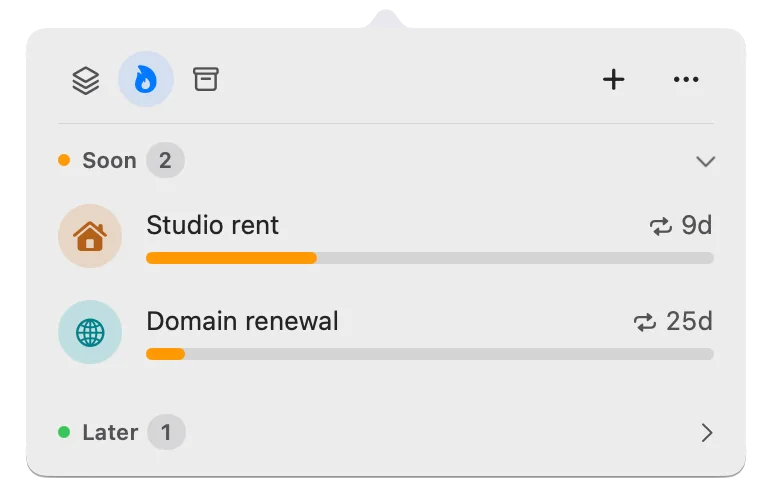
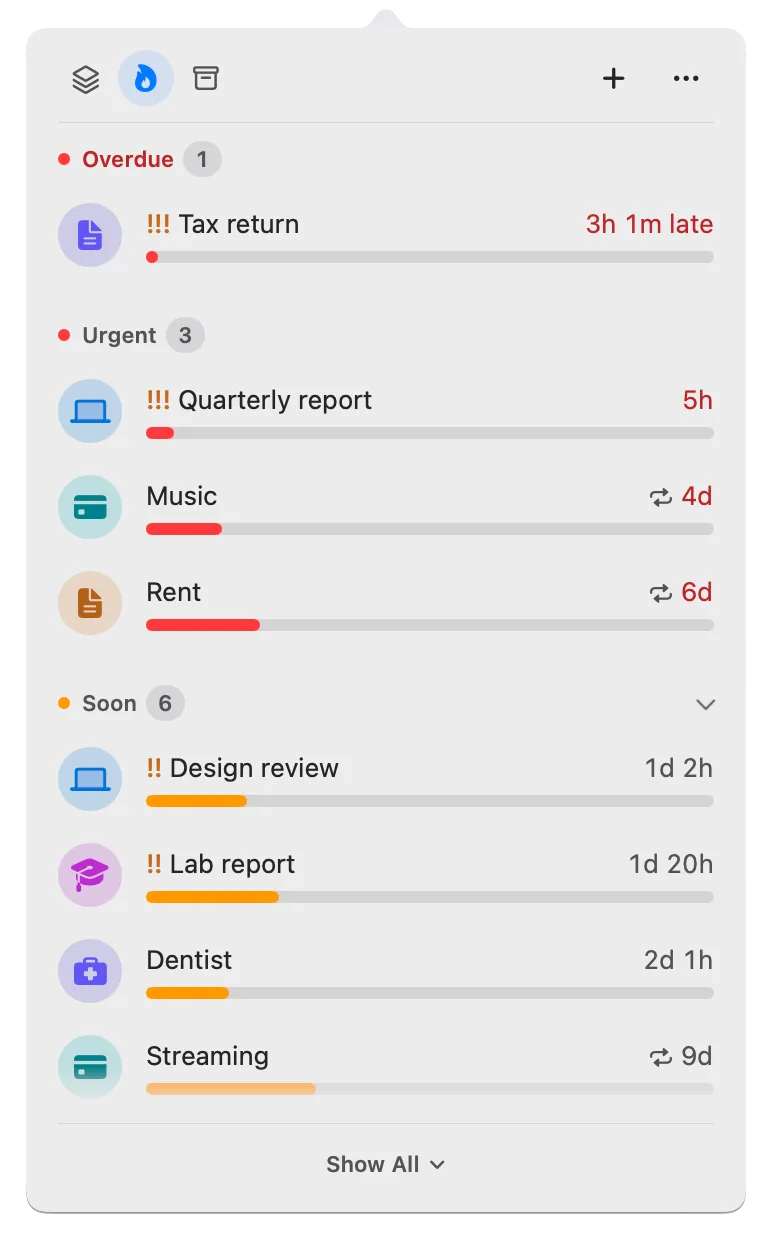
The panel is the list that opens when you click Deadline Bar in the menu bar, and the menu bar shows the first deadline in it. Up Next, the panel’s main list, is sorted by urgency unless you change it (the get started guide shows the panel step by step).
What decides the section
Up Next puts the bands above into four sections: Overdue, Urgent, Soon, and Later. Deadline Bar has two kinds of deadline, and each is placed by its own rule:
- A Task, the kind for work you spend time on, is placed by the share of its own time left. It’s Urgent at 10% or less, and Soon above that, up to 30%. You can change both in Settings → General. A Task longer than 2 days is also Soon 2 days before it’s due and Urgent 1 day before, at the latest.
- A Date, the kind for a day to be ready for, like a renewal or an exam, is placed by days left. It’s Urgent at 7 days or less, and Soon above that, up to 30 days.
Later holds everything with more time than that. Overdue means past its due time, for either kind. The color guide explains the two rules with examples.
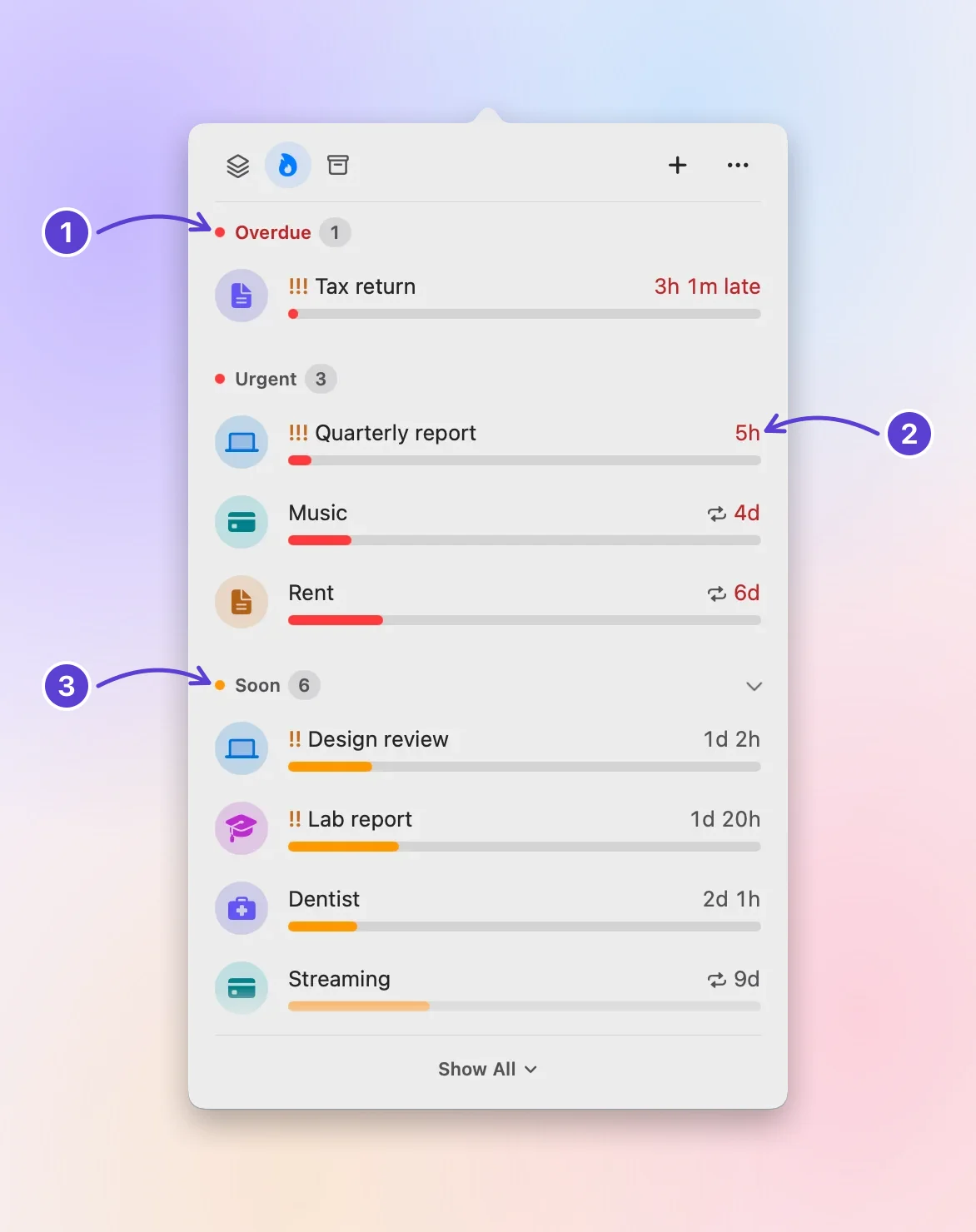
- Overdue comes first
- Red: little time left
- Yellow: running short
The full order
Up Next applies five rules, in this order:
- Section. Overdue first, then Urgent, Soon, and Later.
- Last hour. Inside a section, a deadline in its last hour moves to the top, above higher priorities. Change the window in Settings → General → Move to top before it’s due: 30 minutes before, 1 hour before (the default), or Never.
- Day. Then the nearest day first.
- Priority. On the same day, high before medium before low, and deadlines with no priority last.
- Due time. Then the earliest time first.
A higher priority never jumps a section or a day. An important deadline in Soon stays below an unmarked one in Urgent, and one due Friday stays below one due Thursday. If the important one should come first, start it anyway, move its due date earlier, or have it turn yellow and red sooner: right-click it and choose Urgency… (a deadline longer than 2 days only).
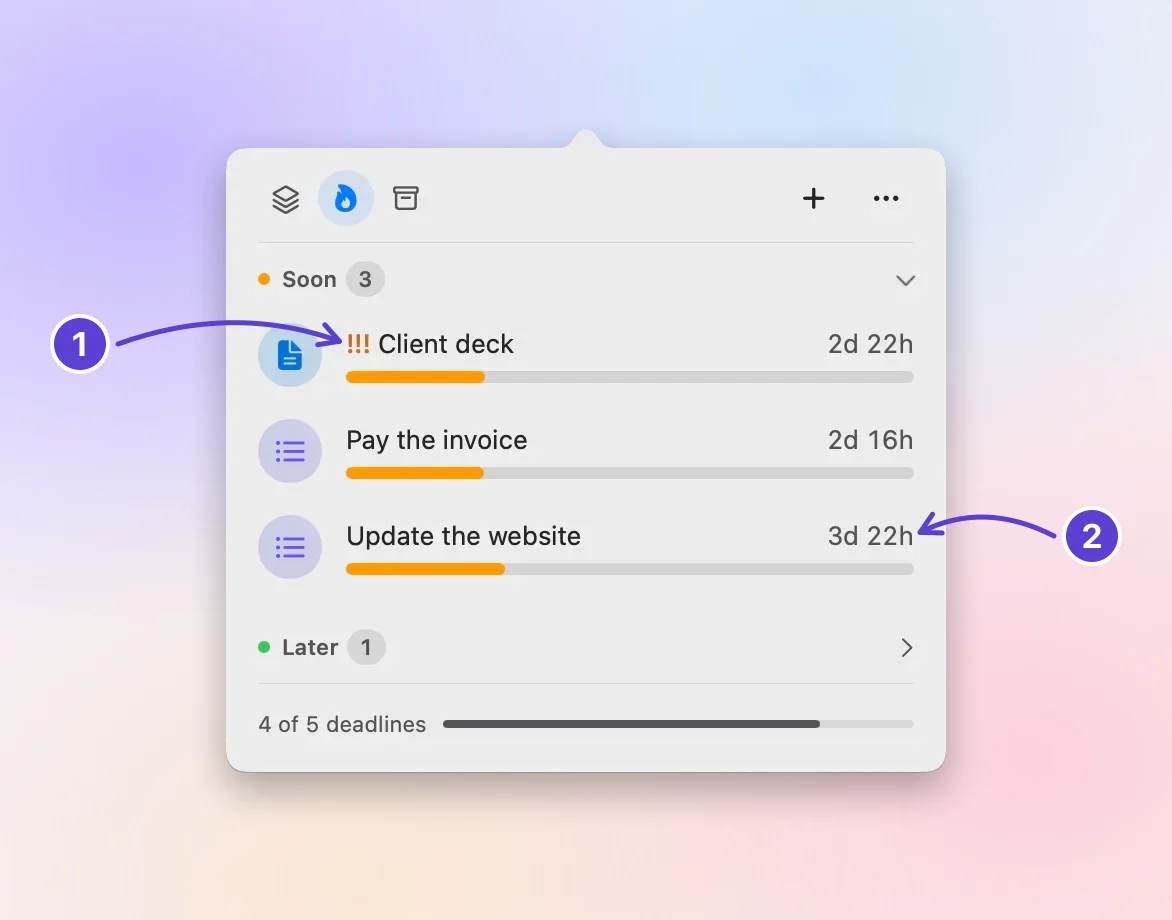
- Same day: priority leads
- The next day comes after
Mark a priority
You can set Priority in three places:
- In Quick Add (Control-Option-D, Control-Option-D⌃⌥D): click Show More, then use the Priority row.
- In the deadline’s form: right-click its row and choose Edit…, then use the Priority row.
- On the row itself: right-click it and choose Priority, then Low, Medium, or High.
The row shows !!!, !!, or ! before the title, and the list reorders at once. To see the rules from inside the app, click ⋯ in the panel and choose Sort By → Why This Order?.
Other ways to sort
Sort By in the panel’s ⋯ menu (also Sort by in Settings → General) offers Urgency (the default), Due Date, Least Time Left (%), and Most Time Left (%). The other three still put overdue deadlines first, then any in their last hour (the Move to top window), and ignore priority for the rest. Choose Due Date if you’d rather see small tasks due tomorrow above larger work due later. Urgency is the only one that uses everything in this guide.

When you’re already working on something
Focus is a timed work session on one Task (a Date is only watched, so it has none), and it’s in the free version too. If a Task in a more urgent section, or one ahead of yours in the same section (due on an earlier day, or the same day with a higher priority), is waiting while you work, the Focus page (the view of your running session) names it as “more pressing” and offers Switch, which moves the session to that deadline. “More pressing” follows the rules above, not effort or dependencies, and nothing changes until you choose.
Next step
Open your list and ask the one question of each deadline: would it hurt if this slipped? Mark the one or two that would with !!!, and leave the rest alone. When the top item is a large piece of work, read the timeboxing guide next for how to give it a fixed block of time.
Questions
Does the order change during the day?
Yes, without you doing anything. A deadline moves up when it crosses into Soon or Urgent, or enters its last hour, and Deadline Bar reorders the list at that moment. Between those moments the order stays put, so the list doesn’t shuffle while you read it.
Does a priority stay when a deadline repeats?
Yes. When you mark a repeating deadline done, the next round keeps its priority, with its name and reminder. If the next round matters less, right-click its row, choose Priority, then None.
Does priority change the color of a deadline?
No. Color shows time left only. Priority changes the order inside a section and shows as !!!, !!, or ! on the row.
Can Deadline Bar estimate how long a deadline will take?
No. It knows when each deadline started and when it’s due, not how much work it needs. Estimate effort yourself, and split a large deadline into smaller ones with their own dates.
How do you prioritize tasks with the same deadline?
When two tasks are due at the same moment, the due date can’t choose between them, so ask which one would hurt more to slip, and start that one. If they matter equally, start the one with more work left: a short task can still fit at the end, and a long one can’t. In Deadline Bar, give the one that matters more a higher Priority, and it leads whenever the two are due the same day in the same section.
Trademarks belong to their owners; Deadline Bar isn’t affiliated with them.
Let the list put the next one first
See your deadlines in your Mac’s menu bar, colored green to red as time runs out, and choose what to do next.

Read next
Green, yellow, red: how Deadline Bar shows a deadline’s urgency
A Task turns yellow at 30% of its time left and red at 10%; a Date at 30 and 7 days. Learn to read the three colors, and why time left isn’t the same as effort.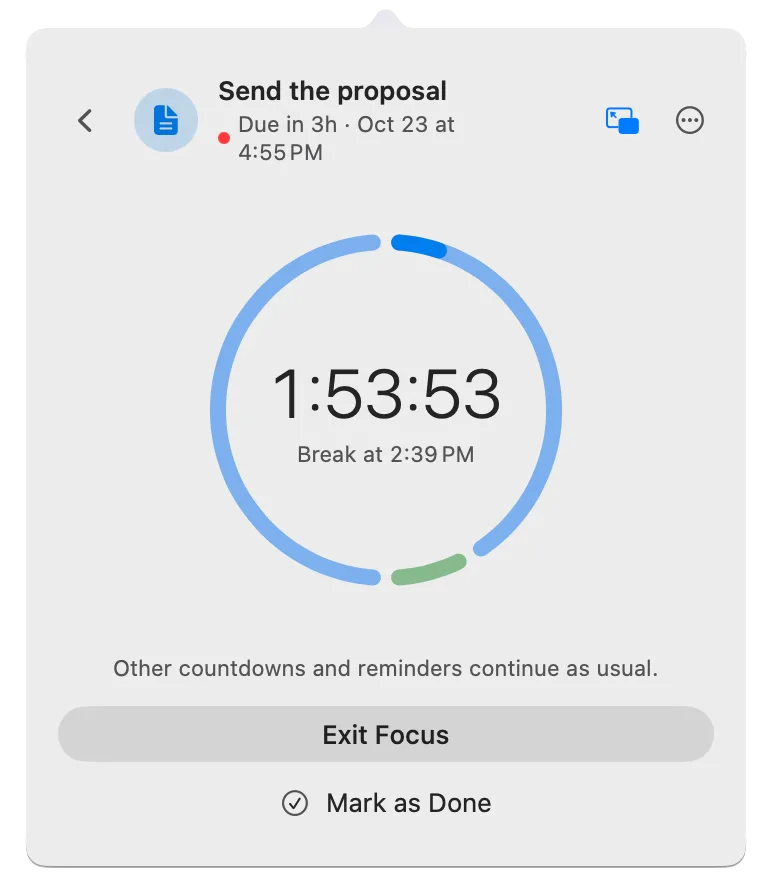
Timeboxing: how to work on one task in a fixed block of time
Pick one task, give it a fixed block of time, and stop when it ends, finished or not. How to choose the length and breaks, where timeboxing breaks, and a free Mac timer.