Green, yellow, red: how Deadline Bar shows a deadline’s urgency
A Task turns yellow at 30% of its time left and red at 10%; a Date at 30 and 7 days. Learn to read the three colors, and why time left isn’t the same as effort.
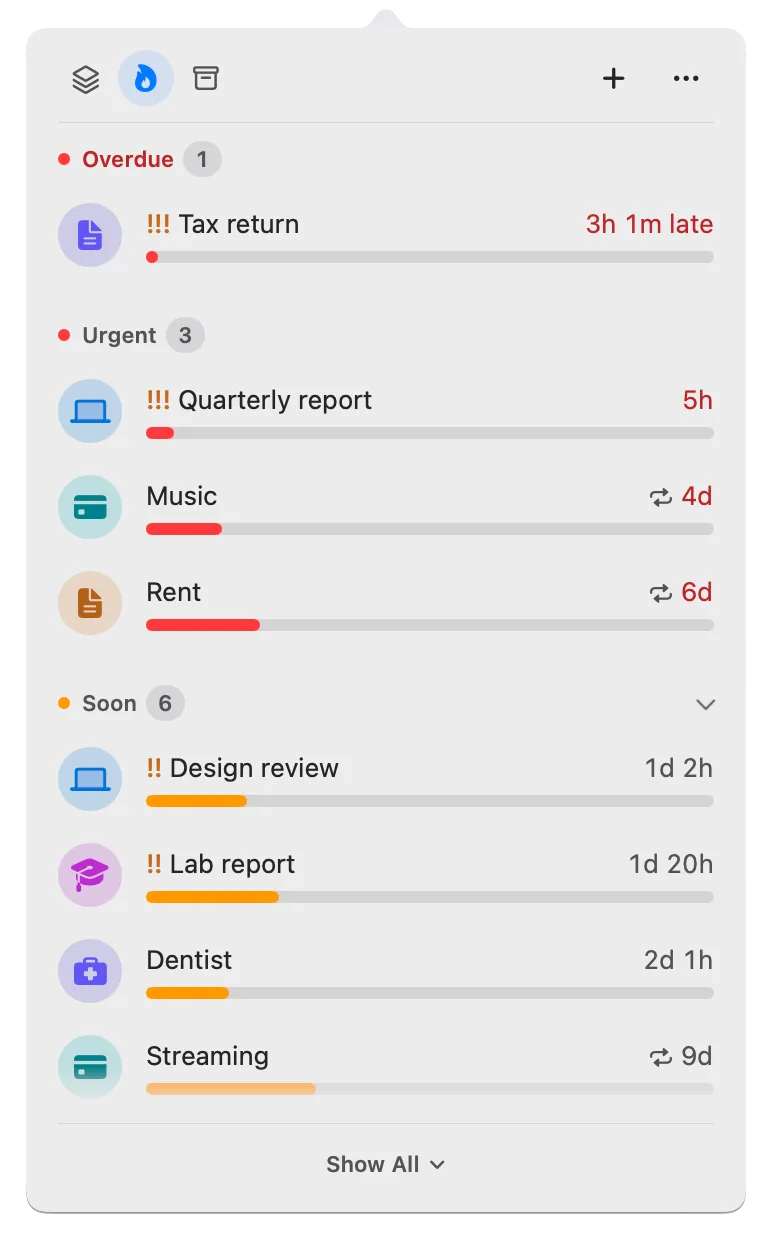
A list of due dates tells you what’s due soonest. It doesn’t tell you which deadline has used up most of the time it had. Deadline Bar colors each deadline by that instead. A Task, work you spend time on, turns yellow when 30% of its time is left and red at 10% (by default). A Date, a day to be ready for rather than a piece of work, like a renewal or a bill, turns yellow 30 days before it’s due and red 7 days before. Green means most of its time is left, yellow means it’s time to plan, and red means its time is nearly gone.
Deadline Bar is a Mac app that keeps your most urgent deadline in the menu bar at the top of your screen and lists the rest in a panel (the list that opens when you click it), most urgent first. This guide explains exactly when each color appears, why it’s measured this way, and what the colors can’t tell you. Everything here works in the free version.
Two rules, one for each kind
A Task is colored by the share of its time left. Its time counts from the start of the day you add it to Deadline Bar (or from a start date you set) to the moment it’s due, not from when you were given the work. A repeating Task’s time runs from the round before’s due, the first round too. A Date is colored by the days until it’s due.
That start matters. Work you were handed two weeks ago and add today counts as if you got it today, so it stays green longer than it should. Add deadlines the day you get them, and treat anything you add late with extra care.
Why the share of time left works for Tasks
Compare two Tasks at 10:00 AM on a Monday (an example):
- A report you added 30 days ago, the day you got it, due Thursday at 10:00 AM: 3 days of its 33 are left, so about 9% of its time remains.
- A slide deck you added this morning, due tomorrow at 5:00 PM: counted from the start of today, 31 of its 41 hours are left, so about 76% of its time remains.
By date, the slide deck comes first. By share of time left, the report does: it has used over nine tenths of its time, while the deck has used about a quarter. The share puts a two-day task and a two-month project on one scale. With the standard settings, a two-month thesis turns yellow with about 18 days left, and a two-day task with about 14 hours left.
The share doesn’t suit a Date. A yearly renewal measured that way would turn red more than a month before it’s due and stay red for weeks. A bill isn’t work spread over its year; you need to act as it gets close. So a Date counts days.
How to read the three colors
| Color | Task (share of its time left, by default) | Date (time until due) |
|---|---|---|
| Green | More than 30% | More than 30 days |
| Yellow | More than 10%, up to 30% | More than 7 days, up to 30 days |
| Red | 10% or less, or overdue | 7 days or less, or overdue |
You can change the Task thresholds in Settings. The Date thresholds aren’t in Settings, and they’re exact intervals, not calendar months: a Date due Oct 18 at 11:59 PM turns yellow on Sep 18 at 11:59 PM and red on Oct 11 at 11:59 PM.
A Task longer than 2 days also turns yellow 2 days before it’s due and red 1 day before, at the latest, so a long one never sits green on its last day. A single deadline can also choose its own times, as the last part of this guide shows.
Up Next, the panel’s main list, sorts deadlines under four headings by color: Overdue and Urgent (red), Soon (yellow), and Later (green). A short routine for reading them:
- Go through red and overdue items first. For each, decide whether it needs you today. If it can’t be done in time, ask for a new due date now, or change the date in the app if it was yours to set.
- For each yellow item, decide when you’ll work on it, today or later this week, and put that on your calendar.
- Scan the green ones for big jobs. A large Task can be green and still need you to start now.
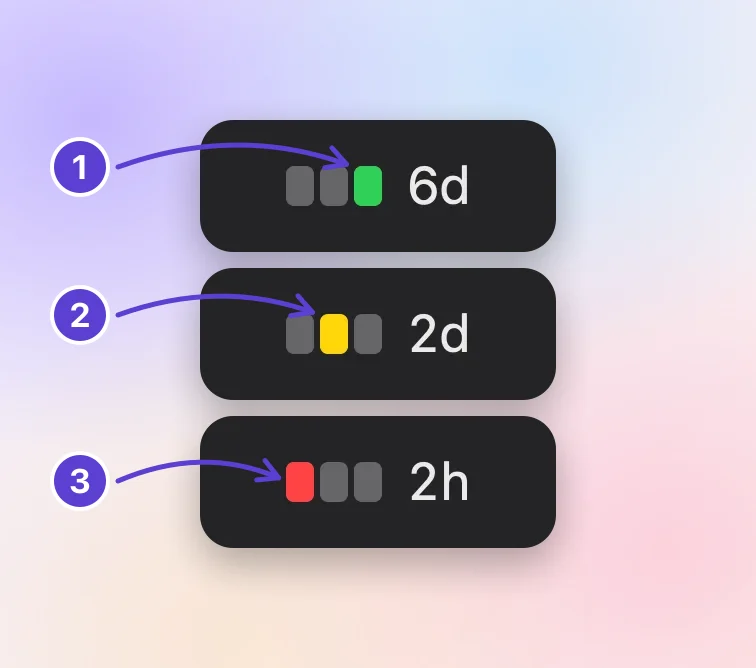
- Green: plenty of time
- Yellow: running short
- Red: little time left
Where the colors break: time isn’t effort
The color measures the clock, not the work. It doesn’t know how long a Task takes, when you work, or whether a cutoff is hard. A green Task with two weeks left and three weeks of work in it is already late. A red Task that takes ten minutes is fine.
So after reading the color, ask one more question: how long will this take? If the honest answer is more than the time left, start it now, whatever its color. The colors also don’t know what a deadline costs to miss: a red library book and a red tax filing aren’t equal. The guide to competing deadlines covers effort, consequences, and Priority, and timeboxing one task helps you start a big one.
Colors in Deadline Bar
Each row in the panel has a bar that drains from its start (the start of the day you added it, or its start date) to the moment it’s due, drawn in the deadline’s color. A Date’s color goes by days left, though, so a yearly renewal’s bar can be nearly empty while it’s still green. The time left beside the bar turns red when the deadline is red or overdue, and stays gray otherwise.
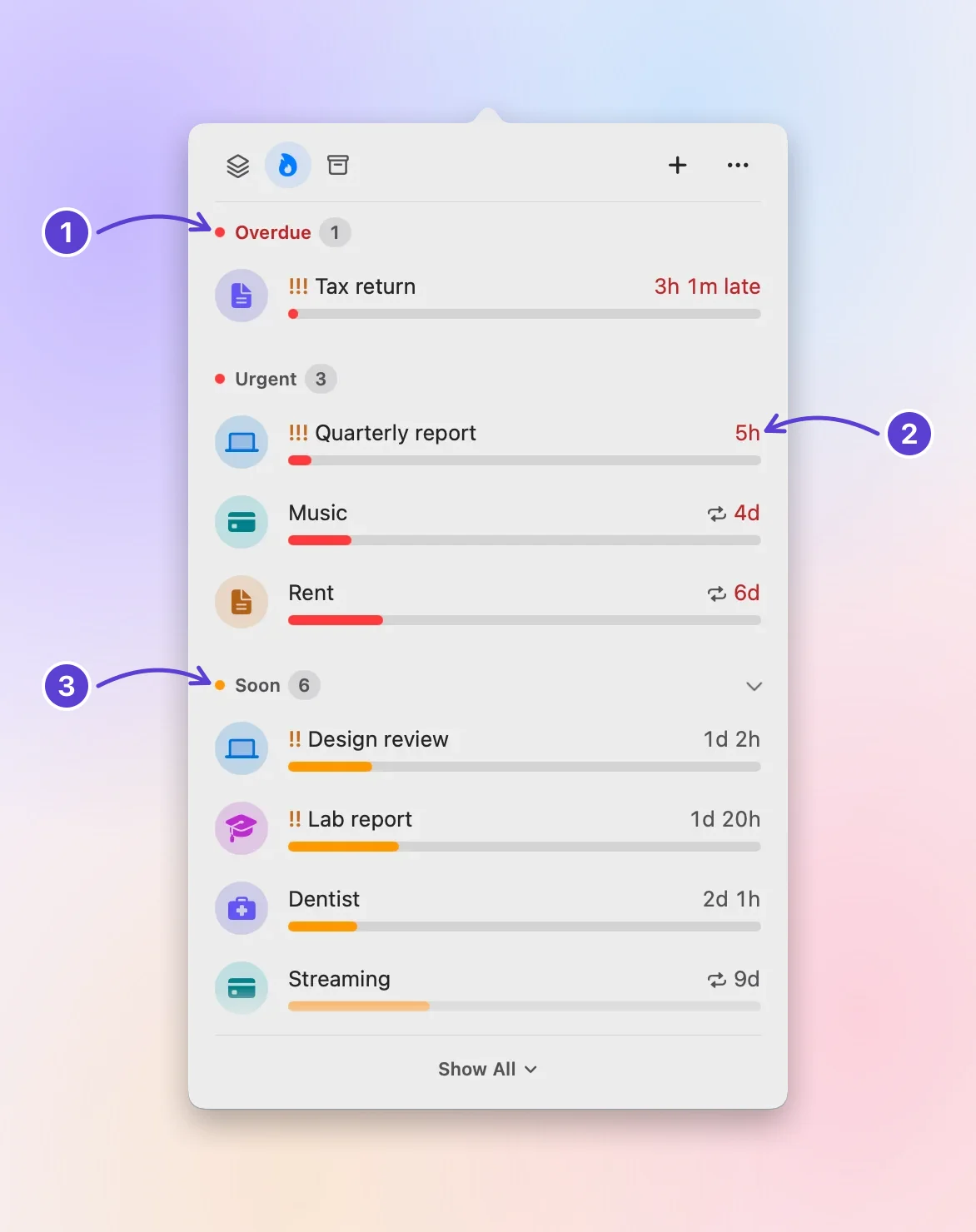
- Overdue comes first
- Red: little time left
- Yellow: running short
The menu bar item shows the most urgent deadline beside three small blocks, and one block lights up at a time: the right one in green, the middle one in yellow, the left one in red. When the deadline is overdue, all three light. The menu bar countdown guide explains which deadline it shows.
To change the Task thresholds:
- Click the menu bar item, click ⋯, and choose Settings….
- In General, set Soon (when a Task turns yellow) to 20%, 25%, 30%, 40%, or 50% of its time left.
- Set Urgent (when it turns red) to 5%, 10%, or 15% of its time left.
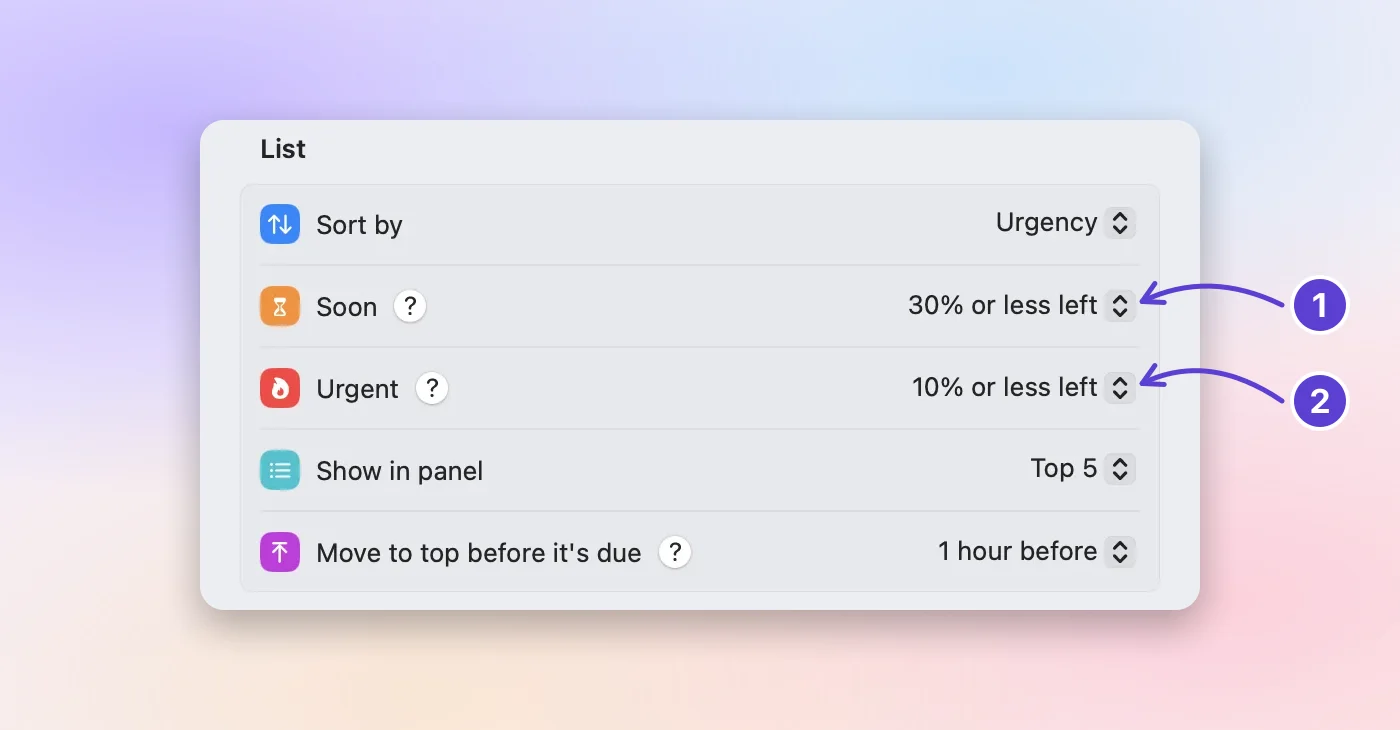
- Soon: when it turns yellow
- Urgent: when it turns red
The panel, the menu bar, and the order of Up Next follow the new thresholds right away. Higher thresholds, such as 40% and 15%, turn every Task on Default yellow and red sooner, which matters most on long ones.
Change when one deadline turns yellow or red
Settings sets the default. One deadline can choose its own, if it runs longer than 2 days from its start to its due:
- Right-click its row in the panel and choose Urgency…. In its form (right-click, Edit…), the Urgency row opens the same panel.
- Choose Soon (when it turns yellow) and Urgent (when it turns red): Urgent from 1 day to 1 month before it’s due, Soon earlier than Urgent.
- Read the day under each name: that’s when it changes. Default goes back to Settings for a Task, and to a month and a week before for a Date.
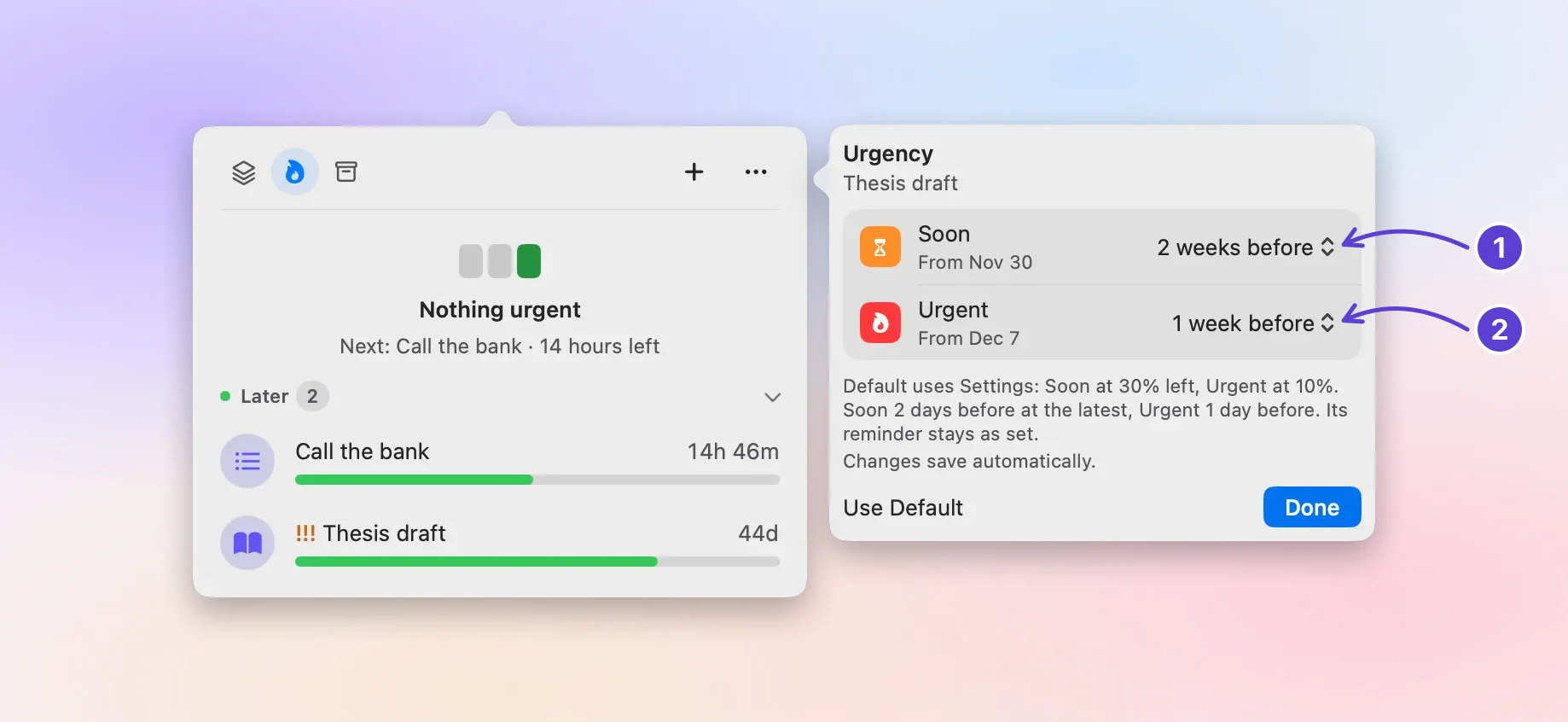
- When it turns yellow
- When it turns red
It changes the deadline’s color and its place in Up Next, not its reminder. From a row, each choice is saved at once; from the form, when you click Save. A deadline of 2 days or less has no Urgency: its share of time left decides.
If a Task’s work can’t begin until later, give it a start date and its time counts from then; the start dates guide shows how.
What to do next
If you use Deadline Bar, open the panel and look at every red item: can you finish it in the time it has left? To choose between several deadlines of the same color, read how to prioritize competing deadlines.
Questions
Why is my renewal red when it’s still a week away?
It’s a Date, and Dates turn red with 7 days or less left, so you have time to act before the charge. A Task due in a week turns red only if that week is 10% or less of its time, which means it was added more than about ten weeks before it’s due.
Can I change when Dates turn yellow and red?
For one Date, yes: right-click it and choose Urgency… (a Date more than 2 days from its start to its due). Settings has no Date thresholds, so every other Date uses 30 days and 7 days.
Why is a deadline due tomorrow green?
It’s a Task with a short window that has barely started, such as one added this morning and due tomorrow evening. It turns yellow and red as its own time runs down.
Do I have to choose Task or Date every time?
No. Quick Add, the window for a new deadline, starts on Task, and the built-in groups choose for you: a deadline in Subscriptions or Bills is a Date, and one in Work or Study is a Task. The built-in groups come with the free version.
What do red, yellow, and green mean in a project status report?
Many teams rate each project green, yellow (or amber), or red: on track, at risk, or off track, often called a RAG status. Someone judges that by hand, from how the work is going. Deadline Bar’s colors look alike but mean something narrower: they’re computed from time left alone, so they warn you about the clock, never about the work.
Trademarks belong to their owners; Deadline Bar isn’t affiliated with them.
See every deadline’s time left at a glance
See your deadlines in your Mac’s menu bar, colored green to red as time runs out, and choose what to do next.

Read next
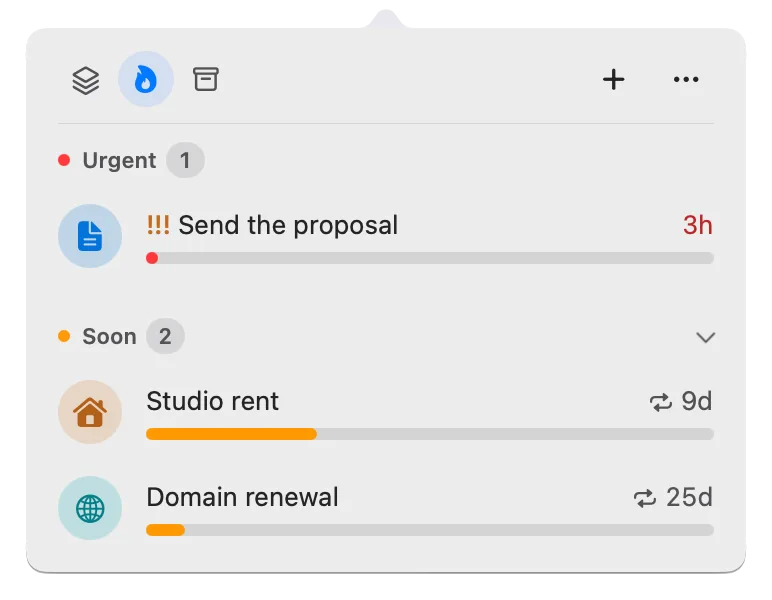
How to prioritize competing deadlines: what to do first
When several deadlines compete, sort them by how much of their time is left, then by what a slip would cost. A worked example, and how to do it on your Mac.
Mac menu bar countdown to your next deadline
Put a deadline countdown in your Mac menu bar, visible in every app: set a due time, see which deadline it picks and why, and finish it.